It's sitting in my office now and it works....:D
More later... much to do...
 This morning, Liz woke up, tapped the bookmarked link on her iPhone, and then tapped "Click Mr. Coffee ON Button." A few minutes later, she went downstairs and was greeted with a fresh, hot pot of coffee :)
 It looks like we'll have remote control of the grinder timer by the end of the week, along with power for Mr. Coffee and the Gaggia Classic!
 Added today are Duemilanove and Mega clones from DF Robot, a Chinese company, as well as their Romeo robotics board (pictured, $36) which is essentially a Duemilanove with the SMD ATmega328's 2 extra analog pins exposed (Seeeduino style), male header pins, on-board buttons, I2C headers, and an L298 motor driver with screw terminals.
 Also added is the Displayduino (pictured, $70, which I noticed at Sparkfun), the core of the MondoMatrix modular system for controlling large numbers of LEDs or servos or whatever. Displayduino acts like a Sanguino with USB, screw terminals, and an RS485 port driver for communication in addition to the ATmega644's two UARTs.
 Windell from Evil Mad Scientist Laboratories ("EMSL") announced a new Arduino-compatible board today: Diavolino!
 After missing the May 17 deadline, I was able to get two boards in for the May 31 DorkbotPDX PCB order. That order has taken longer than previous ones though, since the fab house quoted a much higher price than for previous orders. Fortunately, Laen was able to find a different manufacturer for the panel and stick with the $5/square inch (for three boards *shipped*) pricing structure-- woohoo!!
 Trying to spread traces around, I wondered how the rounded wire bend routing options worked in CadSoft EAGLE. There's a free-form, spline sort of wire bend option, and I went around to all the traces on the latest minimalduino version (which needs a better name btw), widening and pushing and pulling traces to try to fill empty areas. Sort of looks hand-drawn, kind of hippyish. I was hoping to find a way to eliminate one of the jumper wires, but no luck. I introduced an air-wire, actually, but can fix that with a little nudging.
 Not sure whether to get a few of the rounded or "normal" versions when the DorkbotPDX PCB order is due. I got the idea trying to arrange the traces in the lower left and upper middle areas, after working in some patterning in the diagonals. Your opinions are most welcome!
 The ArduPilot Mega by SparkFun ($60) is an extension of the original ArduPilot, but as its name implies, now sports an ATmega1280 as its main processor. Designed to be the brains behind a UAV or radio-controlled flying vehicle, it's all ready to hook up to a GPS receiver, servos, RC I/O, accelerometers and gyros, etc. It's amazing how much is packed in there-- it even has a secondary ATmega328 and multiplexer.
 From Spikenzie Labs, the folks who make the Voice Shield and Altoids tin-sized Prototino comes a "SIP" (Single In-line Package) Arduino-compatible board "Sippino" ($16 kit). It can be mounted vertically or horizontally in a breadboard and has a 6-pin FTDI breakout header for programming, though no power regulation or reset.
 After striking out at the Electronics Flea Market Saturday, I stopped at Fry's for a fresh pair of clippers and soldering tips, and picked up a small case too-- a Serpac M4. I used some free protoboard Laen sent me (THANKS!) to build a simple Arduino-compatible circuit to fit inside it, with a single button and IR LED, powered by three LR44 (AG13, 357, etc.) button cell batteries; basically a mutetater circuit with one LED instead of four.
 Following Martin Koch's code example, I got the circuit to trigger my 350D's shutter, making it functionally equivalent to a Canon RC-5 remote control. Using an ATmega168 is overkill though: most pins go unused, and it nearly drained the three LR44 batteries when left on all night.
 Three copies of my latest Minimalduino design (V .89) arrived today, fabricated in the DorkbotPDX circuit board order. I built one with all components and it works perfectly, with the exception of the 3.3V regulator having a different pinout than the 75LXX part I used in Eagle-- oops...
 The Arduino FIO, announced at the New York Uno Punto Zero meeting, is Shigeru Kobayashi's Funnel I/O board, now officially in the Arduino stable, manufactured and sold by SparkFun Electronics ($25). It runs at 3.3V, at 8MHz, and includes voltage regulation, a LiPo charging chip, and an XBee socket. Note that the USB connector is only for power, not for programming.
 The Arduino Nano 3.0 by Gravitech ($35) got a lot of press in the last week after being stocked in the Make: Magazine Maker Shed (though it was actually rolled out in July). This revision has LEDs for power, RX, TX, and D13; auto power sensing; power regulation and USB programming interface-- pretty much everything a full-sized Arduino has, plus the two extra analog input pins available on the smd ATmega328.
 I got the latest version (.89) of my Minimalduino board to Laen at DorkbotPDX before the deadline this morning-- looking forward to getting three copies of it!
 Guilherme Martins announced his fantastic "Motoruino" (flickr set) freeduino board on March 9. It has a shield-compatible pin layout, power pins for each Arduino pin, and a L293D motor driver circuit on the right side. I like that he didn't bind the driver to any particular Arduino pins and included three ways to attach motors' leads. I can't wait to get my hands on one.
 Hoping to show off the alarm clock a little, I brought the PPAC (including power block, valve tree, and tank) to the Make:SF Meetup last month, and while talking and hooking it up at the same time, plugged the AC supply into the DC power socket! The voltage regulator fizzled but the power board seems fine otherwise. Strangely, of all things, the LCD display was dead as well... though I may have killed it when disassembling the can..:o I ordered a better looking LCD replacement which I'll install in the next few days-- green-on-black instead of black-on-green: Newhaven NHD-0216K1Z-NSPG-FBW-L.
 The minimalduino project is still moving forward: I'm using a test board I made at home a few weeks ago, populated with as little as possible: chip, caps, resonator, female headers, reset and male FTDI header. I'll move a few traces around but it's pretty much there, and hope to get three test boards made through the DorkbotPDX PCB order, deadline noon on March 29. I've built a spreadsheet with costs, and it seems like I could make a batch of 25 kits at just under $15 each. I'm not sure if it's worth the trouble though.
 A few weeks ago, I built a new coffee grinder timer with a re-worked sketch and single board, then handed it off to fellow coffee fiend HF for ideas on how to make the ideal grinder timer. One thing we agreed on is that tenths of a second would be cool, so last night I had a great time working out a sketch to drive a common anode 3-digit 7-segment display using an SAA1064 IC. Of course having a sketch to start with made things straightforward-- thanks Alessandro Saporetti! I reworked the code to make it more general purpose, using all of the chip's functions including multiplexed (versus not) and changing the constant current output (7 output levels possible, from 3 to 21mA). [Video to come]
 I reworked the one-layer board to got everything routed nicely in two layers, and etched it last night with the layers very well aligned! Now to get flux-- without it, the vias need their own little lead, which is quite a pain. I'll build it out today and test it, then look at board house prices for making a minimal order, seeing how many I'd have to order to get the price down to $10/kit (with no extras). I wonder about rebuilding it in KiCad though-- I've about had it with EAGLE's inefficient UI.
 I've been working on the mutetater program and board, and have it mostly sorted out, including the bulk of the mounting details.
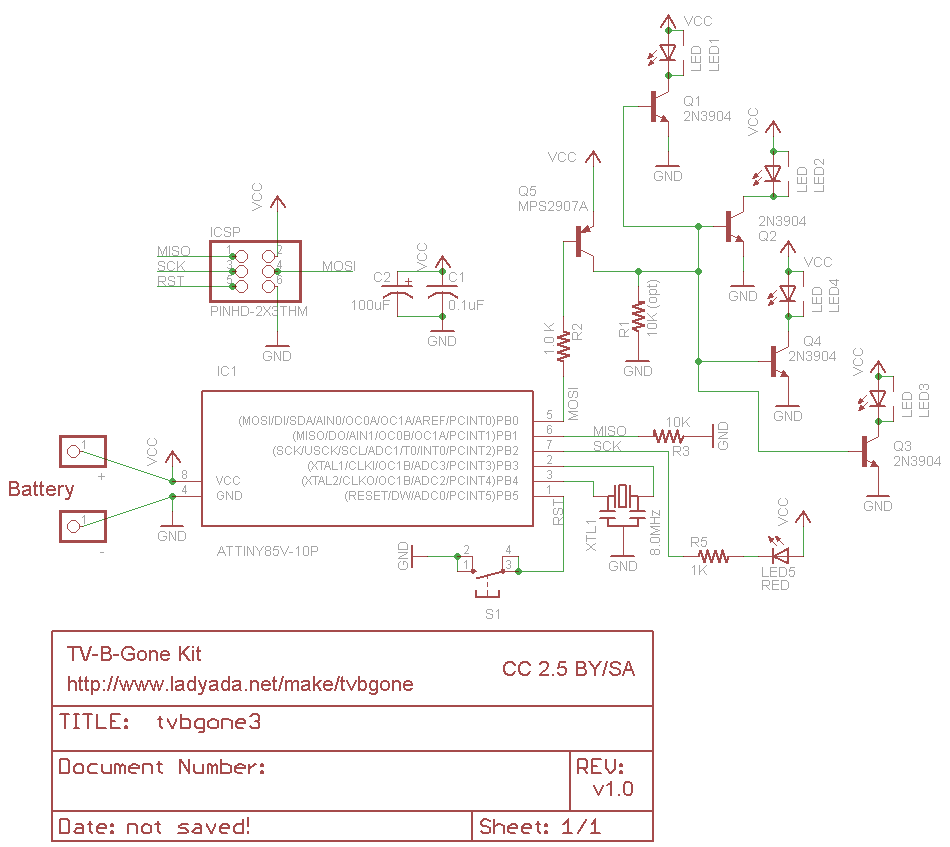
I etched a small 1-sided board to hold my old Arduino Mini, with transistors rigged like the TV-B-Gone v1.2, and headers for four LEDs, a button, ftdi programming cable, and 5V power. I'm using a Bodhilabs "VPack" with a single cr2032 to get 5V, and its header works nicely for mounting a power switch. It all fits in the foam potato, so now to figure out the button and LED mounting.
 I prefer breadboard-friendly Arduino-compatible boards like Boarduino and iDuino, but I keep wanting functionality people have built into shields like Adafruit's Motor Shield and Batsocks' TellyMate Shield.
 This work is licensed under a Creative Commons Attribution 3.0 United States License.